

Creative tools often determine how ideas evolve. In traditional music production, the need to manage software, instruments, and structure influences what gets created. With systems like an AI Music Generator, that influence shifts. The tool no longer dictates the workflow; instead, it adapts to the creator’s intent.
This difference may appear subtle, but it has implications for how decisions are made during the creative process.
From Technical Constraints to Intent-Driven Creation
Why Traditional Tools Shape Outcomes
When using conventional production software:
- Available instruments influence composition
- Interface complexity affects experimentation
- Time investment limits iteration
These constraints often narrow creative exploration.
How AI Systems Remove Initial Barriers
By allowing text-based input, the system removes early-stage friction. In my observation, this leads to:
- Faster idea exploration
- More varied initial outputs
- Less hesitation in experimentation
The user focuses on describing rather than constructing.
Decision-Making Inside AI-Assisted Workflows
Iteration Becomes the Primary Tool
Instead of refining a single composition, users generate multiple versions. Decision-making shifts from:
- “How do I build this?”
to
- “Which version fits best?”
This introduces a selection-based workflow.
Prompt Engineering as Creative Skill
The ability to phrase ideas clearly becomes central. Subtle changes in wording can lead to different outputs, making language itself a creative medium.
How the Generation Process Maintains Coherence
Temporal Consistency Across Sections
Generated tracks often maintain:
- Consistent tempo
- Logical transitions
- Repeating motifs
This suggests that the model tracks structure across time rather than generating isolated segments.
Adaptive Layering of Musical Elements
Different layers—melody, rhythm, harmony—appear to evolve together. This coordination is essential for producing tracks that feel complete.
Step-Based Usage Flow Reflecting Actual Interaction
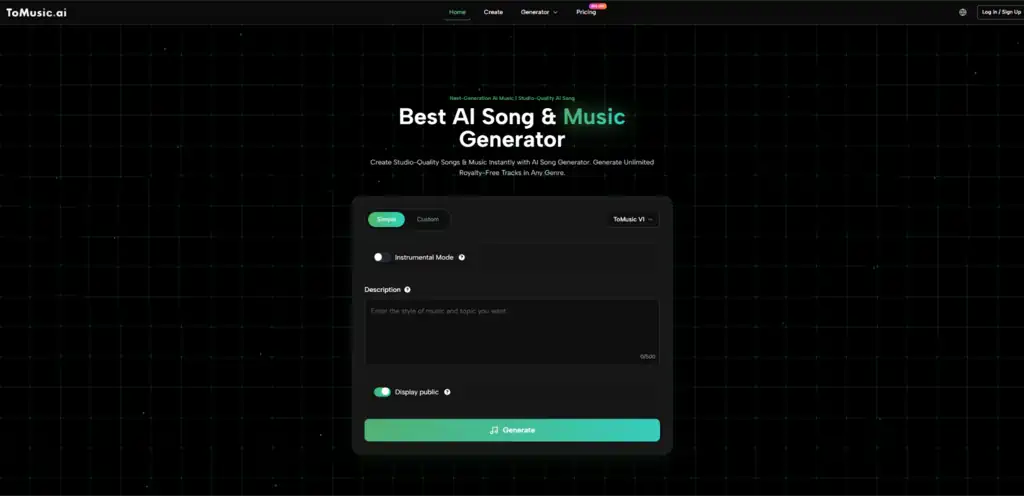
Step 1: Define Creative Intent Through Text
Users input:
- Mood descriptors
- Style references
- Optional lyrics
Clarity at this stage strongly influences results.
Step 2: Adjust Generation Parameters
Users can choose between automated or custom modes, affecting:
- Control level
- Output diversity
Step 3: Generate Multiple Variations
The system produces full tracks. Users often create several versions to compare.
Step 4: Select and Refine Through Iteration
Rather than editing directly, refinement occurs by adjusting prompts and regenerating outputs.
Comparative Perspective on Creative Control
| Dimension | Traditional Production | AI Generation |
| Control granularity | High | Moderate |
| Iteration speed | Slow | Fast |
| Entry barrier | High | Low |
| Creative exploration | Limited by time | Expanded |
| Outcome predictability | High | Variable |
The trade-off is clear: precision decreases, but exploration increases.
Real-World Scenarios Where This Matters
High-Volume Content Production
Creators producing frequent media benefit from rapid music generation without licensing concerns.
Early-Stage Concept Development
Projects in development can quickly establish tone without committing to final production.
Experimentation Across Styles
Users can test multiple genres with the same idea, something that would be time-intensive in traditional workflows.
Observed Constraints in Practice
Reduced Precision in Specific Adjustments
Fine-tuning individual elements remains challenging without regeneration.
Output Variability Across Runs
Consistency between generations is not guaranteed, which can complicate iterative refinement.
Learning Curve in Prompt Design
Although simpler than traditional tools, effective use still requires practice in describing intent.
A Gradual Shift in Creative Roles
The role of the creator evolves from:
- Builder of structure
to
- Director of outcomes
This does not eliminate creativity; it redistributes it. The emphasis moves toward conceptual clarity rather than technical execution.
What This Suggests About Future Creative Tools
If current trends continue, future systems may:
- Offer hybrid control between generation and manual editing
- Improve consistency across iterations
- Provide more transparent mapping between input and output
However, the fundamental idea—creation through intent—will likely remain central.
The significance of these tools is not just in what they produce, but in how they reshape the process of deciding what to create.