

Washington contractors aren’t short on project risks, and the top insurance providers serving this market know it. Between complicated subcontractor relationships, strict state licensing rules, and job sites that change week to week, getting the coverage wrong isn’t just expensive; it’s potentially business-ending. After reviewing dozens of providers across coverage depth, claims performance, and contractor-specific knowledge, the gap between a well-matched policy and a generic one becomes very clear. This guide breaks down five providers worth serious consideration, with real distinctions that matter when a claim actually hits.
The shortlist methodology
Provider profiles were built from publicly available sources: official websites, verified customer reviews, industry directories, and platform ratings. Only companies with a demonstrated track record in the insurance space made the cut. Options lacking sufficient verifiable data were left out entirely.
→ See the full research breakdown
- Affordable Contractors Insurance – Best for small to mid-sized construction contractors and trade professionals
- Genrose Insurance – Best for small business insurance
- Thimble – Best for on-demand small business insurance
- Hiscox – Best for niche insurance and specialty coverage for small businesses and high-net-worth individuals
- AmTrust Insurance – Best for small commercial insurance and workers’ compensation
The Stakes Behind Choosing Top Insurance Providers
Picking the wrong insurance provider doesn’t just cost money upfront. It shows up later, when a claim gets delayed, disputed, or quietly underpaid because a coverage exclusion buried in the fine print applied all along.
Washington contractors face this constantly. Comparing coverage terms across multiple providers is genuinely difficult when policy language shifts between carriers, and what looks like equivalent coverage rarely is.
Specialized providers understand the difference between a general liability policy written for a retailer and one built for a roofing crew working on a commercial project. That distinction matters at claim time.
The right provider tends to show up in measurable ways: a stronger claims settlement ratio, a healthier loss ratio that signals financial stability, and a lower NAIC complaint index score that reflects fewer policyholder disputes. Those numbers tell the real story, and they’re worth tracking before you sign anything.
5 Top Insurance Providers Compared
Note: All data in this table is sourced from review platforms and the official websites of the listed companies.
| Company Name | Years Operating | Headquartered In |
|---|---|---|
| Affordable Contractors Insurance | Est. 2011 | United States |
| Genrose Insurance | Est. 2001 | Scottsdale, Arizona |
| Thimble | Est. 2015 | New York City |
| Hiscox | Est. 1901 | Pembroke, Bermuda |
| AmTrust Insurance | Est. 1998 | New York City, New York |
1. Affordable Contractors Insurance – Best for Contractors Needing Fast, Specialized Coverage
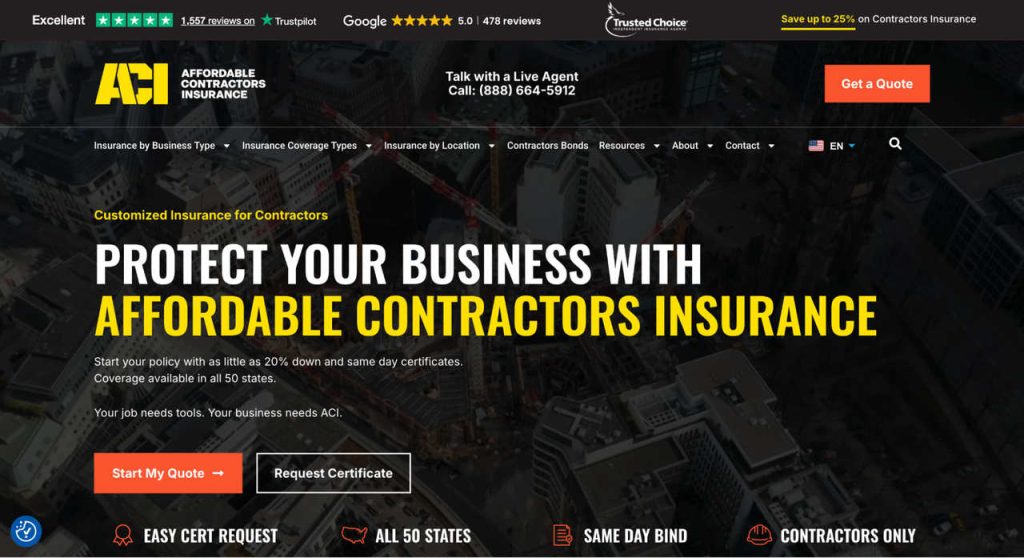
What Is Affordable Contractors Insurance’s Business Model?
Affordable Contractors Insurance is a U.S.-based brokerage built around contractors and construction professionals. They cover the full range of trade coverage needs: General Liability, Workers’ Compensation, Commercial Auto, Builder’s Risk, Tools and Equipment, Umbrella Liability, and Professional Liability. The contractor focus is real here, not a marketing angle. Roofers, electricians, plumbers, HVAC contractors, and remodelers are their actual client base, and their service model reflects that with same-day policy binding and fast certificates of insurance.
Why Pick Affordable Contractors Insurance for Top Insurance Providers?
Washington contractors often lose bids or face job-site delays because they can’t produce a certificate of insurance quickly enough, and Affordable Contractors Insurance addresses that directly with same-day COI turnaround. Their contractor-only focus means the policies they place are matched to trade-specific risks rather than adapted from general business coverage.
What the Reviews Show:
The consistent theme across reviews is speed and accessibility, which are exactly the things contractors care about most. Policyholders point to responsive service and straightforward quoting as standout qualities. That kind of contractor-first responsiveness is hard to match in a crowded brokerage market.
2. Genrose Insurance – Best for Small Business Insurance
What Is Genrose Insurance’s Business Model?
Genrose Insurance is an independent brokerage founded in 2001 and based in Scottsdale, Arizona. Because they operate as brokers rather than agents, they represent the client, not the carrier, which changes the relationship significantly. They work across 13 states and cover health, auto, home, life, liability, and business insurance through dozens of top-tier carriers. Small businesses are a clear priority, with group health, individual health, dental, vision, disability, and Medicare products all in the mix. That breadth makes them genuinely useful for small business owners who don’t want to manage multiple broker relationships.
Why Pick Genrose Insurance for Top Insurance Providers?
Small business owners often get generic coverage because their broker is set up to favor certain carriers, and the broker model at Genrose is structured to avoid exactly that problem. Their multi-state licensing and product depth mean clients get recommendations based on fit, not commission structure.
What the Reviews Show:
Genrose holds a BBB A+ rating, which signals consistent customer service and complaint resolution over time. An A+ BBB rating since 2020 alongside charitable community work (including a $10,000 Make-A-Wish donation in 2025) suggests a company that takes its reputation seriously beyond just policy sales. Clients value the personalized attention that a smaller brokerage can actually deliver.
3. Thimble – Best for On-Demand Small Business Insurance

What Is Thimble’s Business Model?
Thimble is a New York-based insurance platform that flipped the traditional coverage model by making policies available by the hour, month, or year (think coverage you turn on and off like a subscription). Founded in 2015, they cover over 300 professions with products including general liability, professional liability, errors and omissions, business owners policies, commercial property, workers’ compensation, and cyber insurance. Their underwriting uses technology, so quotes come back in minutes, not days. Policies are backed by Fortune 500 and AM Best-rated carriers, which keeps the financial stability argument solid.
Why Pick Thimble for Top Insurance Providers?
Contractors who take on short-term or seasonal projects often overpay for annual policies they don’t fully use, and Thimble’s hourly and monthly options fix that directly. Their 2023 acquisition by Arch Capital Group adds a layer of financial backing that gives the platform real staying power.
What the Reviews Show:
With 621-plus Trustpilot reviews and 86% of them sitting at five stars, the satisfaction signal is unusually strong for an insurance platform. Users highlight how fast the quoting and binding process is, which tracks with a platform that was built around speed from day one. That kind of review consistency is rare in the insurance tech space.
4. Hiscox – Best for Niche Insurance and Specialty Coverage
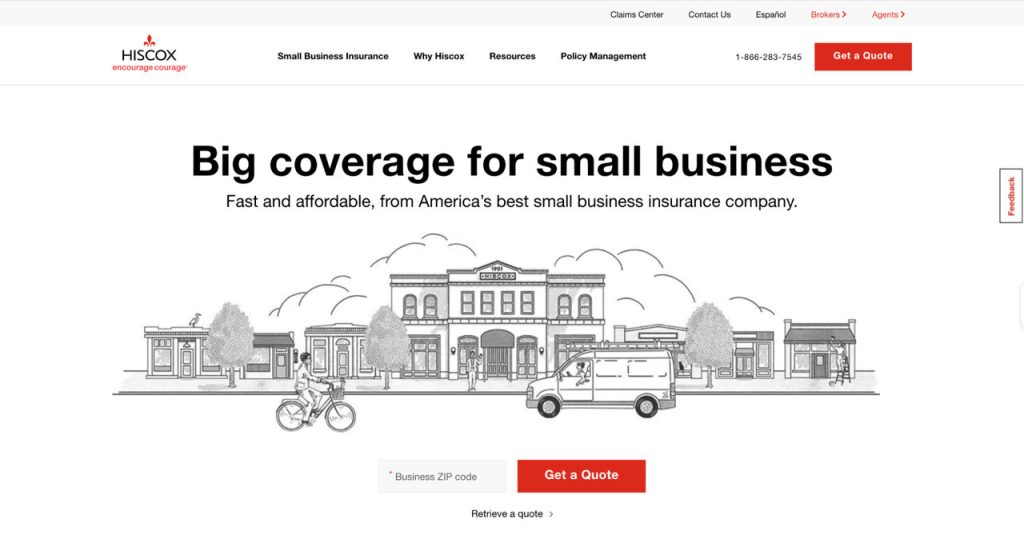
What Is Hiscox’s Business Model?
Hiscox has been operating since 1901, which gives them a depth of experience that newer platforms genuinely can’t replicate. Headquartered in Bermuda, they serve over 600,000 small business customers across 14 countries from 34 offices, covering general liability, professional liability, cybersecurity, and a range of specialty risks (hacking, kidnapping, satellite damage, to name a few). Their AM Best A (Excellent) rating reflects financial strength earned over more than a century. For small businesses and high-net-worth individuals facing risks that standard carriers won’t touch, Hiscox fills that gap well.
Why Pick Hiscox for Top Insurance Providers?
Businesses in architecture, engineering, health, wellness, and similar niches often struggle to find coverage that actually maps to their risk profile. Hiscox has built their entire model around those underserved segments. Multi-product discounts and competitive median pricing make specialty coverage more accessible than most expect.
What the Reviews Show:
Hiscox has been named “Insurer of the Year” six times in the last eight years by Insurance Times Awards, which is the kind of track record that earns genuine credibility. Small business customers particularly respond to the clarity of their policy terms and the responsiveness of their claims process. Being named Top Small Business Insurance Service Provider for 2025 by Insurance Business Review Magazine adds another current data point to an already strong reputation.
5. AmTrust Insurance – Best for Small Commercial Insurance and Workers’ Compensation
What Is AmTrust Insurance’s Business Model?
AmTrust Financial Services is a multinational property and casualty carrier founded in 1998 and headquartered in New York City. They’re the third-largest workers’ compensation provider in the country, with over 500,000 small commercial policies currently in force. Their coverage stack includes workers’ compensation, general liability, business owners policies, cyber liability, and employment practices liability. What sets them apart operationally is AmTrust Genius, their technology-driven quote generation platform, which speeds up the underwriting process for small commercial accounts. With 5,000 to 10,000 employees and 2024 revenue reported at $5.81 billion, the scale here is large, not a boutique operation by any measure.
Why Pick AmTrust Insurance for Top Insurance Providers?
Workers’ compensation for small contractors in complex industries is frequently underserved by carriers who price based on fear rather than actual loss data, and AmTrust’s niche-diversity approach to low-hazard risks addresses that directly. Their 5-Star Claims Excellence Award from Insurance Business America in 2025 signals that the claims side, where it actually counts, holds up.
What the Reviews Show:
AmTrust’s recognition as a Northcoast 99 Best Places to Work winner points to a healthy internal culture, and that kind of workplace stability tends to translate into better client-facing service over time. Their digital experience improvements, recognized by Celent for digital customer experience advancements, are appreciated by small business policyholders who don’t want to manage coverage through phone calls and paper forms.
Evaluation Criteria and Research Approach
The goal behind this ranking was straightforward: identify providers that genuinely serve contractors and small businesses in Washington with demonstrable knowledge, not just a broad appetite for premium volume. Here’s how the selection process worked.
Assembling Information for Analysis
The initial pool was built from multiple source types. Insurance directories, small business review platforms, carrier comparison sites, and official company websites all fed into the early longlist. Profiles were pulled for any provider with a visible presence in contractor or small commercial coverage, regardless of size or national footprint. Case studies and coverage breakdowns were pulled where available to understand how each provider positions their products for trade professionals.
Narrowing Down the Applicant Pool
From the broader pool, options were removed if they lacked verifiable customer feedback, had inconsistent coverage descriptions across platforms, or showed no clear specialization in contractor or small business insurance. Review patterns were analyzed for common themes: claims responsiveness, certificate turnaround speed, policy clarity, and communication quality. Providers with thin or suspicious review histories were excluded even if their marketing copy looked strong.
Authenticating the Selected Items
Each shortlisted provider was cross-referenced by comparing what their official websites claimed against what verified customer reviews actually described. Where those two sources diverged, the discrepancy was treated as a signal worth scrutinizing. Real-world outcomes, including claim resolution patterns and policyholder retention signals, carried more weight than self-reported marketing statements.
The Authority Layer
Authority signals were factored in alongside customer reviews. Industry awards from publications like Insurance Times, Insurance Business America, and Insurance Business Review Magazine were noted as markers of peer recognition. AM Best financial strength ratings were checked for every carrier on the list, because a provider’s financial stability directly affects their ability to pay claims. Mentions in industry publications and earned accreditations (like BBB ratings and Celent recognition) added context to the overall picture.
Top Insurance Providers Case Files
Finally, each provider was evaluated for how well their service pages, verified reviews, and available case examples mapped to contractor and small commercial insurance needs. Providers with dedicated contractor-facing content, verified policyholder reviews that mentioned trade-specific scenarios, and clearly structured coverage offerings for construction and skilled trades scored higher. Generic insurance providers without visible contractor knowledge were filtered out at this stage, regardless of their overall market size.
Finding the Right Top Insurance Providers for Your Needs
No single provider on this list is the right fit for every Washington contractor. The better approach is to match the provider’s actual strengths to where your business sits right now, and where the gaps in your current coverage are. Here’s what to think through before committing.
- Industry/Domain Experience: Look for providers with a clear track record in construction or skilled trades, not just small business insurance broadly. Contractor-specific knowledge affects how policies are structured and how claims get handled when something goes wrong on a job site.
- Features and Service Offerings: Confirm the coverage stack matches your work type. A roofer and a remodeler have different risk profiles, and the right provider should offer products built for both, including General Liability, Workers’ Compensation, Builder’s Risk, and Commercial Auto.
- Pricing Structure: Compare whether annual, monthly, or on-demand pricing matches how your project schedule actually runs. Overpaying for coverage you’re not using is a common and avoidable problem, especially for seasonal contractors.
- Results Measurement: Ask providers about their claims settlement ratio and average processing time. Those numbers tell you whether the coverage actually performs when it matters, not just when you’re signing up.
- Industry Knowledge and Compliance: Washington has specific state DOI regulations and licensing requirements for contractors. The provider you pick should understand those rules and help you stay current, not just issue a policy and disappear.
Final Words
Washington contractors face real risk every day, and the provider backing that risk matters more than most realize. The five options covered here each bring something distinct: contractor specialization, broker independence, on-demand flexibility, niche depth, or workers’ comp scale. Matching the right provider to your actual work type, project volume, and risk exposure is the decision that pays off at claim time. As project scope increases across the state, coverage built for contractors will only become more important.