

Running a multi-million dollar contracting operation means the stakes on every job are real. Most Business Insurance Companies claim they can handle your operational demands, but finding coverage that actually matches your risk profile without eating into margins is a different story. Policy exclusions trap contractors constantly, and premiums in a hardening market aren’t getting friendlier. After reviewing dozens of providers across claims performance, financial strength ratings, and contractor-specific coverage depth, this guide breaks down five options worth serious consideration.
Behind the ranking
Each option on this list was put together by pulling publicly available information from review platforms, carrier directories, official company websites, and published case studies. Only companies with a documented track record in business insurance made the cut. Options without verifiable performance signals were left off entirely.
→ See the full research breakdown
- Unlimited Contractors Insurance – Best for large contractors and construction companies with complex multi-state operations
- Liberty Mutual Insurance – Best for commercial business insurance and workers’ compensation
- InsuredBetter – Best for small business insurance comparison shopping
- The Hartford Contractor Insurance Plans – Best for contractor and small business insurance
- Chubb – Best for large enterprises requiring commercial and personal property and casualty insurance
The Real Impact of Choosing the Right Business Insurance Companies
Picking the wrong insurance setup doesn’t just cost money upfront. It creates gaps that show up mid-project, often when a claim is already moving.
Contractors working at scale deal with policy exclusions that aren’t obvious until something goes wrong. Coverage that looks solid on paper can leave real exposure on multi-state jobs or specialty trades.
The right Business Insurance Companies bring more than a policy document. They bring underwriting knowledge that matches your actual risk, not a generic construction bucket.
That difference shows up in combined ratio performance, which signals how well a carrier manages losses versus expenses. It shows up in claims settlement speed, where slow closures can stall entire projects. And it shows up in J.D. Power satisfaction scores, which reflect whether policyholders actually feel supported when things get hard.
5 Top Picks at a Glance
Note: All data in this table is sourced from review platforms and the official websites of the listed companies.
| Company Name | Established | Headquartered In | Best For |
|---|---|---|---|
| Unlimited Contractors Insurance | – | – | Large contractors with complex multi-state operations |
| Liberty Mutual Insurance | 1912 | Boston, Massachusetts | Commercial business insurance and workers’ compensation |
| InsuredBetter | – | New Brighton, Minnesota | Small business insurance comparison shopping |
| The Hartford Contractor Insurance Plans | 1810 | Hartford, Connecticut | Contractor and small business insurance |
| Chubb | 1882 | Zurich, Switzerland | Large enterprises needing commercial coverage |
1. Unlimited Contractors Insurance – Best for Enterprise-Level Contractor Coverage
What Services Does Unlimited Contractors Insurance Offer?
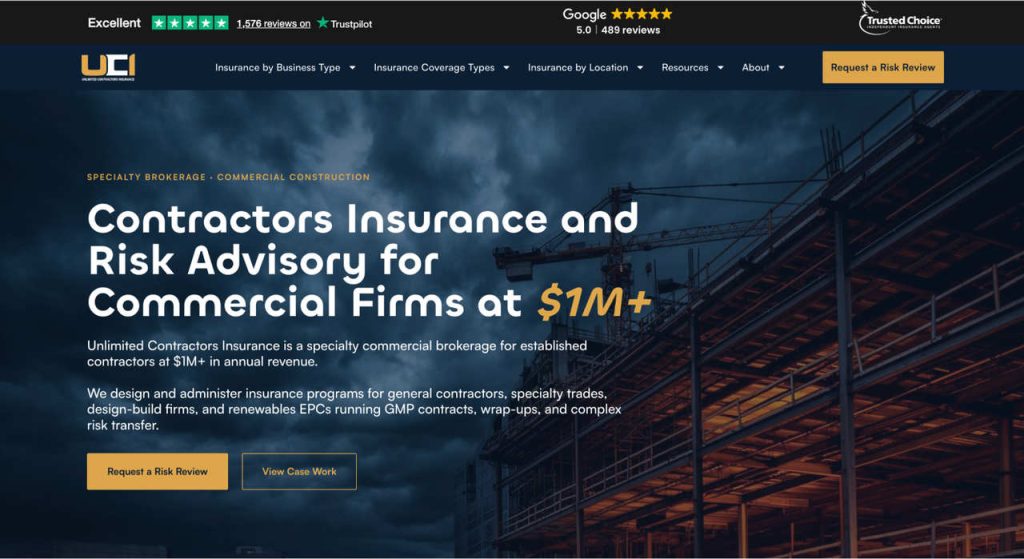
Unlimited Contractors Insurance operates as a division of Affordable Contractors Insurance, built for established contractors who’ve outgrown standard policies. They cover general liability, workers’ compensation, commercial auto, builder’s risk, umbrella liability, property and casualty, tools and equipment, and wrap-up programs. The focus is clear: this isn’t a one-size-fits-all brokerage. Their setup targets higher-revenue construction businesses that need an advisor who actually understands job-site risk, not just someone quoting off a rate card.
What Sets Unlimited Contractors Insurance Apart from Business Insurance Companies?
Contractors managing multi-state operations carry layered exposures that standard policies routinely miss, and Unlimited Contractors Insurance was built to address exactly that. Their private-client advisory model means contractors get dedicated support at the strategic level (not just at renewal time), which is the kind of access that actually produces better risk management outcomes.
Real User Sentiment:
From what the research shows, contractors working with Unlimited Contractors Insurance respond well to the specialized focus and the advisor relationship model. The consistent pattern in feedback points to appreciation for having a team that speaks contractor, not just insurance. That kind of industry-specific fluency is genuinely hard to match at the brokerage level.
2. Liberty Mutual Insurance – Best for Commercial Business Insurance and Workers’ Compensation
What Services Does Liberty Mutual Insurance Offer?
Liberty Mutual is the sixth-largest property and casualty insurer in the world (not a small claim), operating across personal and commercial lines with serious depth. On the commercial side, they handle workers’ compensation, commercial automobile, commercial multiple peril, and general liability across a global footprint spanning more than 900 locations. The company runs through two business units: US Retail Markets and Global Risk Solutions, which give mid-market and enterprise contractors access to coverage that scales with them.
What Sets Liberty Mutual Insurance Apart from Business Insurance Companies?
Many commercial insurers bundle products without truly understanding the operational differences between industries. Liberty Mutual’s century-plus track record gives it underwriting data that most carriers simply can’t match. That depth of historical claims experience translates directly into pricing and coverage terms that reflect real-world loss patterns, not just actuarial estimates.
Real User Sentiment:
Liberty Mutual has built consistent recognition for community responsibility, including a perfect score on the Corporate Equality Index for seven straight years. Honestly, that signals a company that manages its internal operations well, which usually correlates with how they treat policyholders. Reviewers generally cite service consistency as a standout, though large-scale commercial clients note that managing multiple policies sometimes requires proactive communication with your assigned rep.
3. InsuredBetter – Best for Small Business Insurance Comparison Shopping
What Services Does InsuredBetter Offer?
InsuredBetter runs a marketplace model connecting small business owners with independent agents who have access to multiple insurance carriers. On the business side, they cover workers’ compensation, general liability, professional liability, and cyber liability. The real value here is the comparison angle: independent agents can pull quotes across carriers, which means clients aren’t locked into whatever a captive agent’s single carrier happens to offer. Their content team includes licensed insurance agents and trained journalists (which is a genuinely useful combination for buyers trying to educate themselves quickly).
What Sets InsuredBetter Apart from Business Insurance Companies?
Small businesses often struggle to get competitive quotes simply because they’re working with agents who only have access to one carrier’s pricing. InsuredBetter’s multi-carrier marketplace model directly breaks that bottleneck, giving buyers visibility across the market without shopping individually.
Real User Sentiment:
The marketplace model tends to appeal well to small business owners who’ve previously felt stuck with limited options. From what the data shows, users respond positively to the ease of getting multiple perspectives in one place. The platform’s independent agent network adds a layer of human expertise that purely digital quote tools don’t typically offer.
4. The Hartford Contractor Insurance Plans – Best for Contractor and Small Business Insurance
What Services Does The Hartford Contractor Insurance Plans Offer?
The Hartford brings over 200 years of property and casualty experience to contractor insurance, which puts them in rare territory. They offer general liability, commercial auto, and workers’ compensation built for the construction industry, along with contractor-specific add-ons like broad form endorsements, contractors’ pollution liability, and builder’s risk. They also deploy risk engineering specialists who work directly with construction clients on hazard identification. That’s not standard at most carriers, and for contractors managing complex job sites, it’s legitimately useful.
What Sets The Hartford Contractor Insurance Plans Apart from Business Insurance Companies?
The coverage gaps most contractors discover after a claim, like pollution liability and broad form endorsement deficiencies, are exactly what The Hartford has structured its contractor product set to address. Their AM Best A+ rating and Moody’s A1+ rating signal the kind of financial stability that matters when a major claim is on the table.
Real User Sentiment:
The Hartford scores 4.38 overall in customer reviews (strong for a commercial insurer) and earned recognition as an insurance industry leader by Just Capital and CNBC in 2026. Reviewers frequently call out claims processing speed and customer service responsiveness as highlights. That combination of financial strength ratings and actual service quality is harder to find together than it sounds.
5. Chubb – Best for Large Enterprises Requiring Commercial Coverage

What Services Does Chubb Offer?
Chubb holds the title of the largest publicly traded property and casualty insurance company in the world, operating in 55 countries and territories. Their commercial offering spans property and casualty, accident and health, reinsurance, and life insurance, with particular strength in financial lines where they’re the largest writer globally. For large contractors and enterprises, the coverage depth and global reach matter, especially on projects that cross jurisdictions. Their AA and A++ financial strength ratings from major agencies put them at the top of the stability chart.
What Sets Chubb Apart from Business Insurance Companies?
Large commercial clients often face the challenge of finding a single insurer who can handle both domestic operations and international exposure without coverage gaps between policies. Chubb’s global reach and 140-plus years of underwriting history give it the carrier-side depth to take on risk that most others need to syndicate out.
Real User Sentiment:
Chubb earned Business Insurance’s 2020 Innovation Award for their Worldview platform, which reflects a carrier that’s keeping pace with how modern risk management actually works. From what the research shows, enterprise clients tend to value Chubb’s financial strength ratings above almost everything else, followed closely by their coverage breadth in specialty areas. The trade-off (think enterprise pricing) is a real consideration for mid-market buyers evaluating fit.
How These Were Chosen and Verified
Data Collection Phase and Preparation
The starting point for this list was building a broad pool of candidates. Company names were pulled from insurance directories, B2B review platforms, carrier comparison tools, and published industry case studies. The goal during this phase was coverage, not curation. Every company that surfaced with documented activity in business insurance for contractors or commercial clients was added to the working list, regardless of size or brand recognition.
The Shortlisting Pass
From that initial pool, options without verifiable business histories or traceable public records were set aside. Review patterns were analyzed across multiple platforms to identify consistency. Companies where the volume of feedback was too low to draw reliable conclusions, or where claims on official sites couldn’t be matched against any third-party mention, were removed at this stage. The shortlist retained only those providers with enough signal to evaluate meaningfully.
Verification Pass
Each shortlisted company’s website claims were checked against what appeared in independent reviews and published reports. Where a company described specialized contractor capabilities on their site, evidence was looked for in case studies, industry directories, or policyholder commentary that corroborated those descriptions. Discrepancies between stated positioning and documented experience were flagged and factored into the final evaluation.
Industry Recognition and Authority
Award mentions, published rankings, and citations in trade publications were tracked for each company. Recognition from sources like AM Best, Moody’s, J.D. Power, Business Insurance magazine, and Just Capital carried weight here because they reflect external validation rather than self-reported claims. Financial strength ratings were treated as an important authority signal, given how directly they reflect a carrier’s ability to pay claims.
Evidence Specific to Business Insurance Companies
The final filter focused on contractor and commercial insurance fit. Each company was assessed for dedicated service pages addressing construction-specific or commercial-specific risks, verified policyholder reviews from business clients (not just personal lines), and relevant case studies showing real-world application in the commercial space. Companies without clear evidence of focus in business insurance, even if strong generalist carriers, didn’t make the final list.
What to Look For When Choosing Business Insurance Companies
Not every insurance provider is set up to handle contractor-scale demands. The right fit depends on a few factors that go well beyond premium price.
- Industry and Domain Experience: Look for carriers or brokers with documented history in construction or your specific trade. Generic commercial coverage can leave contractor-specific risks exposed.
- Features and Service Offerings: The coverage menu matters. Verify that policies include contractor-specific additions like pollution liability, builder’s risk, and wrap-up programs where your projects require them.
- Pricing Structure: Premium cost is only one part of the equation. Review how deductibles, coverage limits, and endorsement costs interact before comparing quotes across carriers.
- Results Measurement: Ask how a provider tracks claims outcomes. Combined ratio performance and average claims settlement speed are practical signals of how well they operate when it counts.
- Industry Knowledge and State Insurance Requirements: State DOI requirements and NAIC standards vary across jurisdictions. Any provider handling multi-state contractor operations needs to show they understand those differences, not just at the policy level, but operationally.
Final Take
Choosing the right Business Insurance Companies comes down to how well a provider understands the actual risk profile of the work you’re doing. Financial strength ratings and claims speed matter more than brand size alone. For multi-million dollar contractors, the gap between adequate coverage and the right coverage can be expensive to discover mid-project. As commercial insurance markets keep tightening, contractors who lock in strong carrier relationships and advisory support early will carry a real structural advantage.